
Personalized mRNA Cancer Therapy Reaches a Phase 3 Milestone in Melanoma


Moderna and Merck have announced a major Phase 3 milestone in personalized cancer therapy.
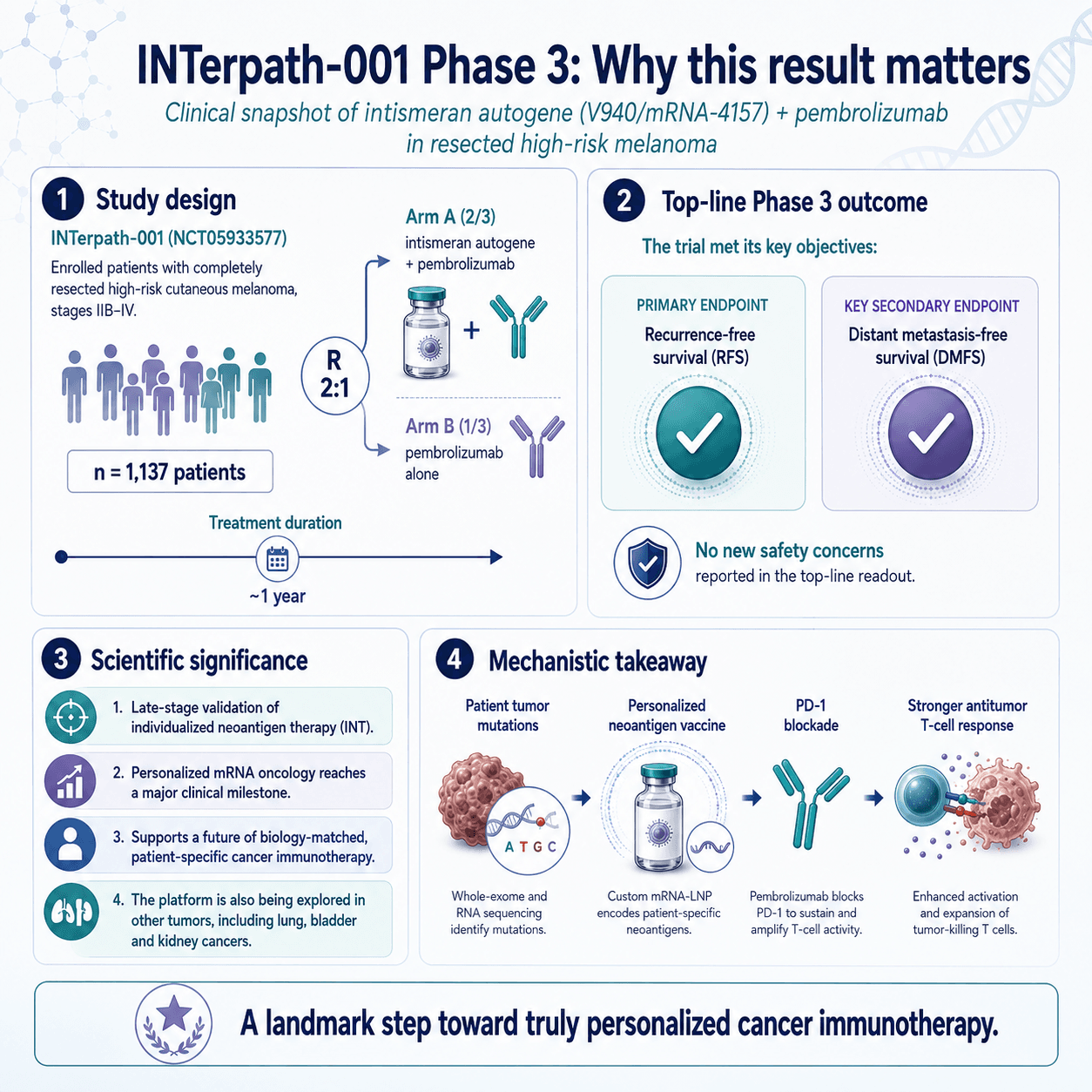
The INTerpath-001 trial evaluated intismeran autogene (V940/mRNA-4157) combined with pembrolizumab (KEYTRUDA) in patients with completely resected, high-risk stage IIB–IV melanoma.
According to the top-line announcement, the study met its:
• Primary endpoint: recurrence-free survival (RFS)
• Key secondary endpoint: distant metastasis-free survival (DMFS)
Compared with pembrolizumab alone, the personalized mRNA therapy combination significantly improved both outcomes.
This matters because INTerpath-001 represents the first positive Phase 3 result for an individualized neoantigen therapy and a major clinical milestone for mRNA-based cancer treatment.
So, what is V940?
V940 is not a conventional vaccine manufactured identically for every patient. It is designed individually from the molecular profile of each person's tumor.
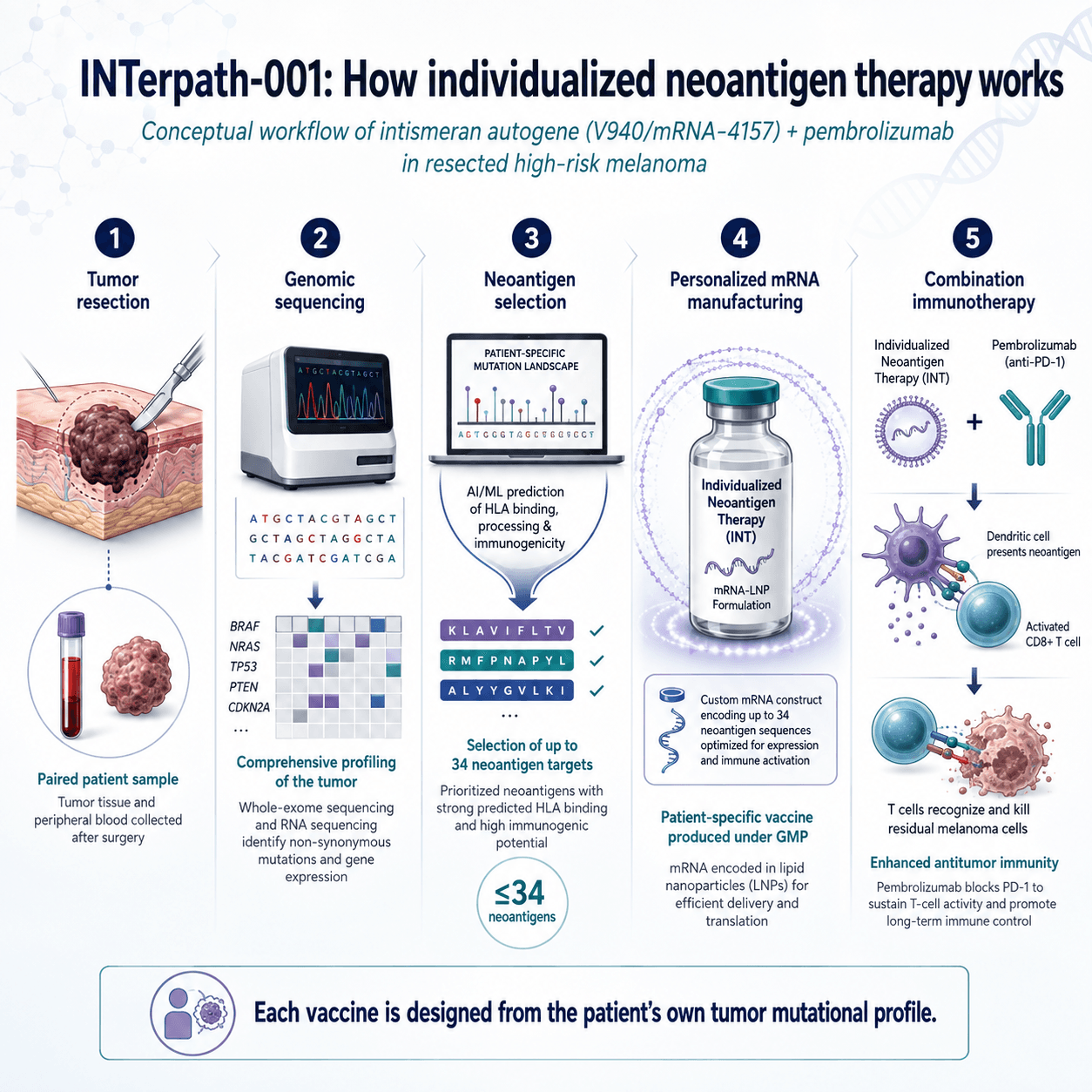
The workflow can be simplified into five steps:
1. The tumor is removed and molecularly analyzed
After surgery, tumor tissue is sequenced and compared with normal material from the same patient. This reveals tumor-specific mutations. RNA sequencing also helps determine which mutated genes are actually being expressed.
2. Candidate neoantigens are selected
Tumor mutations can generate abnormal proteins that are not present in healthy cells. Fragments of these proteins can act as neoantigens.
Computational algorithms rank these candidates according to factors such as expression, HLA presentation and predicted immunogenicity. For V940, up to 34 neoantigens can be selected.
3. A personalized mRNA construct is manufactured
The selected neoantigens are encoded into an individualized mRNA medicine. The aim is to provide the immune system with a molecular description of the patient's own cancer.
4. The immune system learns the targets
After administration, cells translate the mRNA and produce the encoded antigenic sequences. These are processed and presented to immune cells, helping generate tumor-specific T-cell responses.
In simple terms, the treatment attempts to teach the immune system exactly what that patient's cancer looks like.
5. Pembrolizumab removes an immune brake
Cancer cells frequently exploit the PD-1 pathway to suppress T-cell activity. Pembrolizumab blocks PD-1, helping maintain the activity of tumor-reactive T cells.
The combination therefore attacks the problem from two directions:
V940 identifies the targets. Pembrolizumab helps the immune system remain active against them.
Why is the Phase 3 result so important?
Personalized cancer vaccines have been investigated for years, but producing a therapy individually for every patient is technically and biologically difficult.
The treatment requires integration of pathology → genomics → transcriptomics → bioinformatics → immunology → mRNA manufacturing → clinical oncology.
A positive Phase 3 result therefore validates much more than one drug. It provides strong clinical support for the idea that information extracted from an individual tumor can be converted into a patient-specific therapeutic strategy.
What do we know — and what do we not know yet?
The announcement confirms that INTerpath-001 met its RFS and DMFS endpoints and reported no new safety concerns.
However, this is currently a top-line Phase 3 readout. The full dataset — including hazard ratios, detailed subgroup analyses, survival curves and longer-term follow-up — still needs to be presented.
This distinction is important. The previously reported 49% reduction in the risk of recurrence or death comes from the earlier Phase 2b KEYNOTE-942 study, not from the newly announced Phase 3 dataset.
Why could this extend beyond melanoma?
The underlying principle is not specific to melanoma. The same individualized neoantigen strategy is being explored in other tumor types, including lung, bladder and renal cancers.
The broader question is therefore:
Can oncology increasingly move from treating a tumor category to treating the molecular identity of an individual patient's cancer?
INTerpath-001 brings that possibility one important step closer.
In one sentence: INTerpath-001 is important because it shows, at Phase 3 level, that a cancer treatment can be designed from the mutations of an individual patient's tumor and successfully combined with checkpoint immunotherapy to reduce the risk of recurrence and distant metastasis.
#PersonalizedMedicine #PrecisionOncology #mRNA #CancerImmunotherapy #Melanoma #Neoantigens #Genomics #Bioinformatics #TranslationalScience